The bespoke software development process starts before coding

Follow the bespoke software development process from workflow discovery and prototyping through integration, testing, release, adoption and improvement.
The bespoke software development process starts before coding
Discover the workflow and its exceptions
Define outcomes and product boundaries
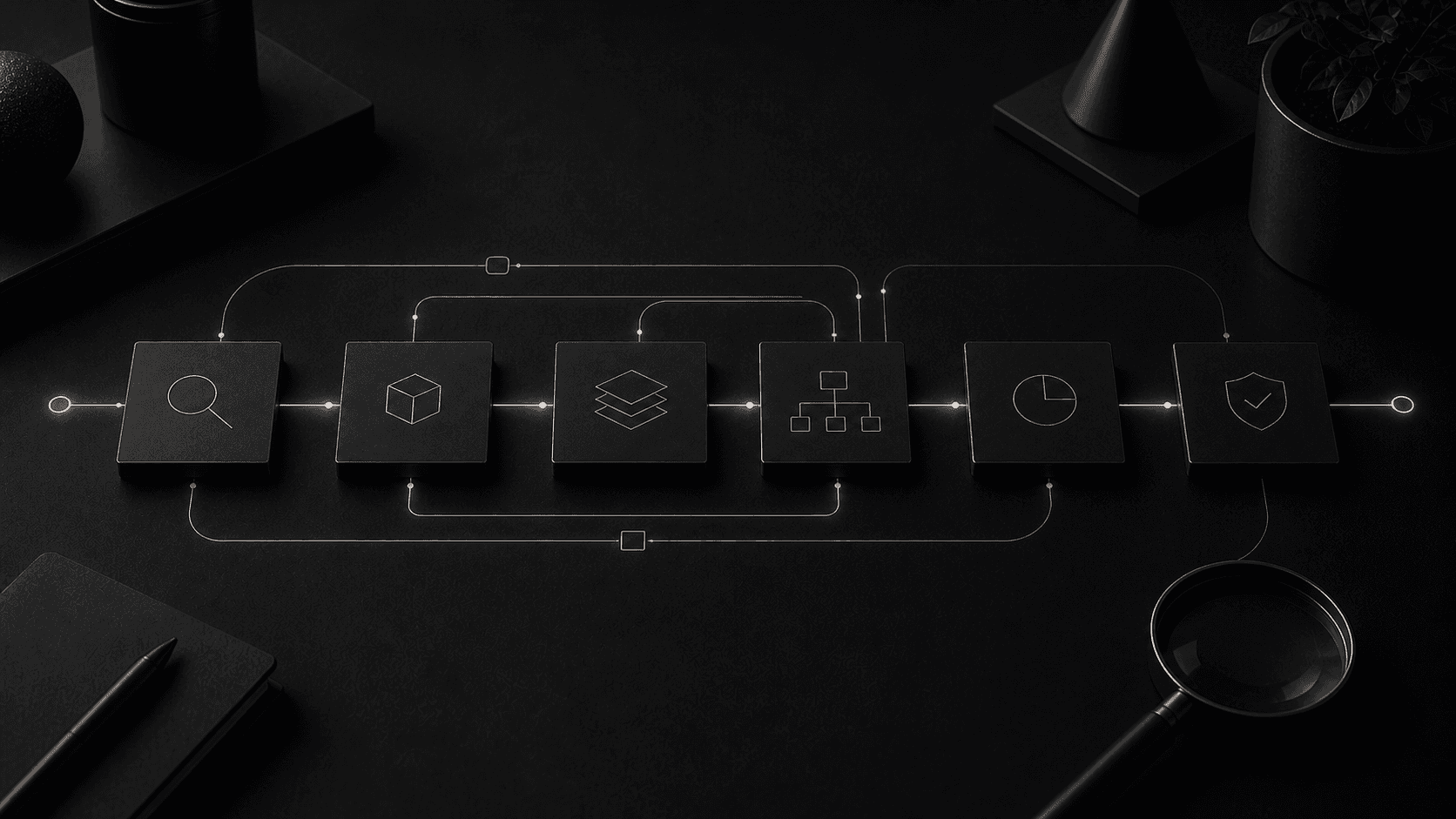
The stages that turn an operational problem into dependable bespoke software without fixing the wrong process in code.
Authoritative source assigned for every shared business record.
Failure controls designed together: retry, reconciliation and human exception review.
“The stages that turn an operational problem into dependable bespoke software without fixing the wrong process in code.”Bespoke Software Development Process field note
The bespoke software development process begins by understanding decisions, information and exceptions inside the real workflow. Coding starts only after the problem boundary, users and measures of success are clear. A disciplined engagement then moves through modelling, prototyping, technical design, integration, testing, controlled release and adoption. This order matters because software can automate a weak process perfectly. Discovery reduces the risk of building the wrong system efficiently.
Record the current delivery decision, the person accountable and the evidence that will demonstrate the software outcome. This turns a general intention into an operating decision. It also makes later review more useful because the team can distinguish an isolated exception from a repeated condition that needs a change to the process, content or system. The record can remain concise, but it should be consistent enough for another responsible person to understand what was decided and why.
Record the current delivery decision, the person accountable and the evidence that will demonstrate the software outcome. This turns a general intention into an operating decision. It also makes later review more useful because the team can distinguish an isolated exception from a repeated condition that needs a change to the process, content or system. The record can remain concise, but it should be consistent enough for another responsible person to understand what was decided and why.
Observe how work actually moves rather than relying only on a written procedure. Identify triggers, owners, hand-offs, data sources, delays and workarounds. Exceptions deserve particular attention because a system designed only for the happy path forces staff back into spreadsheets and messages when reality differs. The discovery output should define which problem belongs inside the first release and which adjacent issues remain outside it.
Record the current delivery decision, the person accountable and the evidence that will demonstrate the software outcome. This turns a general intention into an operating decision. It also makes later review more useful because the team can distinguish an isolated exception from a repeated condition that needs a change to the process, content or system. The record can remain concise, but it should be consistent enough for another responsible person to understand what was decided and why.
Record the current delivery decision, the person accountable and the evidence that will demonstrate the software outcome. This turns a general intention into an operating decision. It also makes later review more useful because the team can distinguish an isolated exception from a repeated condition that needs a change to the process, content or system. The record can remain concise, but it should be consistent enough for another responsible person to understand what was decided and why.
Translate the operational problem into measurable outcomes such as reduced duplicate entry, faster approval or a complete audit history. Then define the users, roles, data and rules needed to produce those outcomes. A boundary prevents the first release from attempting to replace every connected process. It also gives stakeholders a stable basis for accepting or rejecting new ideas during delivery.
Record the current delivery decision, the person accountable and the evidence that will demonstrate the software outcome. This turns a general intention into an operating decision. It also makes later review more useful because the team can distinguish an isolated exception from a repeated condition that needs a change to the process, content or system. The record can remain concise, but it should be consistent enough for another responsible person to understand what was decided and why.
Prototype important journeys and rules with the people who perform the work. Early models can be diagrams or simple interactive screens; their purpose is to expose misunderstanding cheaply. Test permission boundaries, exception handling and terminology as well as the normal sequence. A realistic prototype often reveals that two teams use the same word differently or that an apparently simple approval contains several unrecorded decisions.
Record the current delivery decision, the person accountable and the evidence that will demonstrate the software outcome. This turns a general intention into an operating decision. It also makes later review more useful because the team can distinguish an isolated exception from a repeated condition that needs a change to the process, content or system. The record can remain concise, but it should be consistent enough for another responsible person to understand what was decided and why.
Technical architecture should follow the required scale, security, maintainability and integration environment. Define a source of truth for each record and how connected systems exchange changes. Avoid duplicating sensitive data without a reason. APIs need validation, retries, monitoring and clear ownership when an external service changes. Bespoke software vs off-the-shelf helps determine whether this custom responsibility is justified.
Record the current delivery decision, the person accountable and the evidence that will demonstrate the software outcome. This turns a general intention into an operating decision. It also makes later review more useful because the team can distinguish an isolated exception from a repeated condition that needs a change to the process, content or system. The record can remain concise, but it should be consistent enough for another responsible person to understand what was decided and why.
Deliver vertical slices that connect interface, rules and data for one useful journey. This creates something stakeholders can evaluate and exposes technical risk earlier than building isolated layers for months. Automated tests protect stable rules, while exploratory testing checks language, edge cases and human understanding. Security, accessibility and performance belong inside each increment rather than a final quality phase.
Record the current delivery decision, the person accountable and the evidence that will demonstrate the software outcome. This turns a general intention into an operating decision. It also makes later review more useful because the team can distinguish an isolated exception from a repeated condition that needs a change to the process, content or system. The record can remain concise, but it should be consistent enough for another responsible person to understand what was decided and why.
Profile existing data before migration, including duplicates, missing values and inconsistent identifiers. Rehearse the transformation and reconcile totals so the new system does not inherit uncertainty invisibly. Release to a controlled user group when possible, with monitoring, support and a rollback path. A launch date is not evidence of adoption; users need training, ownership and a route to report exceptions.
Record the current delivery decision, the person accountable and the evidence that will demonstrate the software outcome. This turns a general intention into an operating decision. It also makes later review more useful because the team can distinguish an isolated exception from a repeated condition that needs a change to the process, content or system. The record can remain concise, but it should be consistent enough for another responsible person to understand what was decided and why.
After release, measure the outcomes defined during discovery and review how staff handle cases the design did not anticipate. Prioritise improvements that remove repeated friction or risk rather than filling a feature backlog. Versatech's operational systems service connects discovery, design and engineering so the people changing the system understand the process it supports. Related automation examples show how bounded workflows can evolve responsibly.
Record the current delivery decision, the person accountable and the evidence that will demonstrate the software outcome. This turns a general intention into an operating decision. It also makes later review more useful because the team can distinguish an isolated exception from a repeated condition that needs a change to the process, content or system. The record can remain concise, but it should be consistent enough for another responsible person to understand what was decided and why.
Planning a website or digital system?
Versatech brings senior strategy, design and engineering into one delivery team. The first conversation identifies the useful next step before scope is fixed.
START A PROJECTSEE SERVICESStart with a focused 30-minute discovery call and leave with a clearer route forward.