The website development process reduces uncertainty in stages

The website development process explained: discovery, content, architecture, design, engineering, testing, migration, launch and measured improvement.
The website development process reduces uncertainty in stages
Discovery turns the brief into a defined problem
Information architecture and content define what the website says
A stage-by-stage explanation of how a professional website moves from an uncertain brief to a dependable launch.
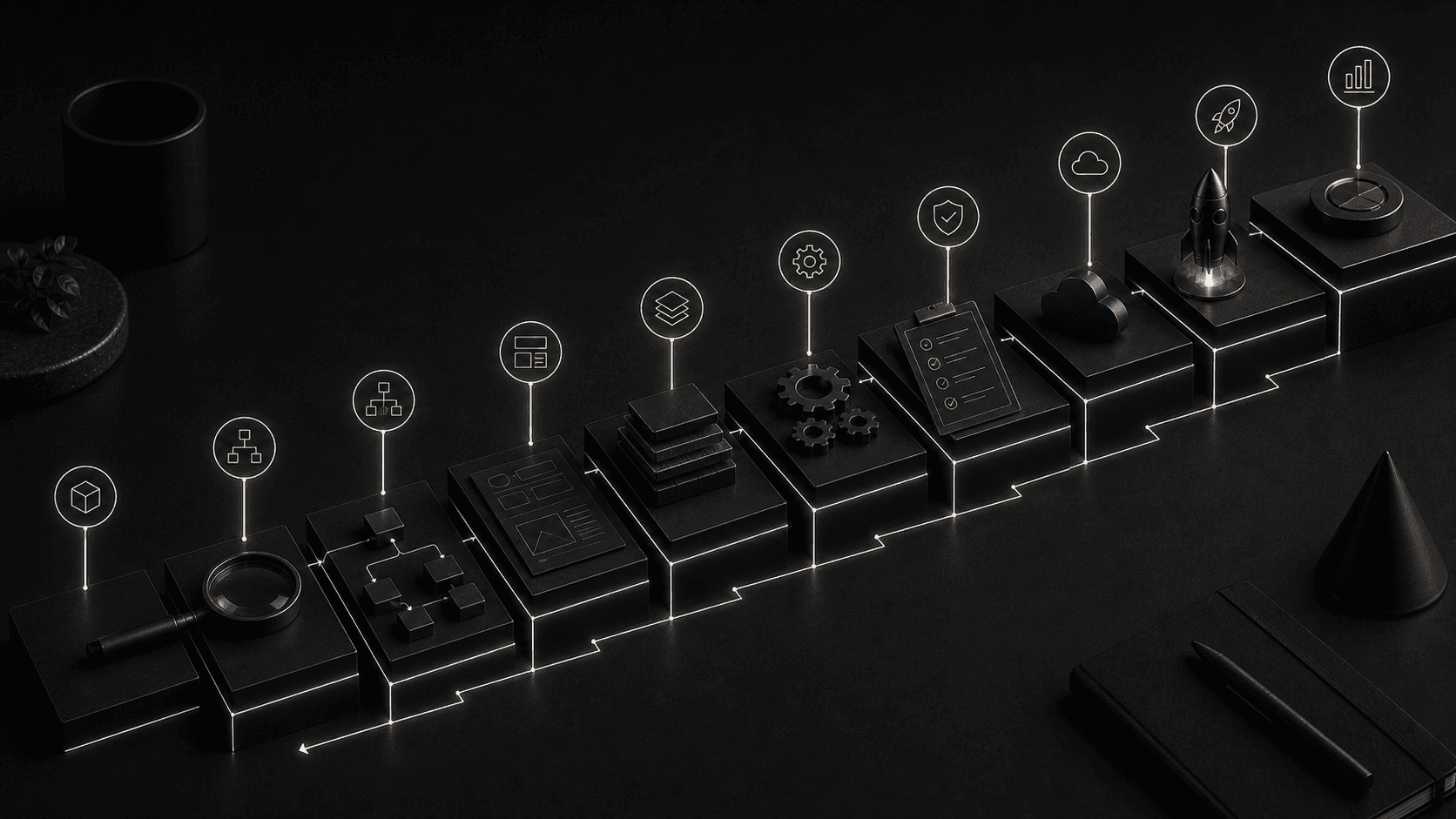
Connected stages take a website from initial discovery through measured improvement after launch.
Accountable delivery team should own the relationship between strategy, design, engineering and release.
“A dependable launch is the result of uncertainty being removed in stages, not a design being rushed into production.”Website development planning review
The website development process turns an initial commercial need into a tested, operable website through a sequence of evidence and decisions. Discovery defines the audience and problem. Content and architecture organise the answer. Design establishes hierarchy and behaviour. Development implements the system, while testing, migration and launch controls protect quality and existing value. Each stage should reduce uncertainty before the next becomes expensive, rather than treating the project as a visual concept followed by code.
A professional process is not a rigid chain in which one discipline finishes and disappears. Content can expose a weakness in the planned navigation. A prototype can reveal that a technical assumption creates friction. Performance testing can change an image or animation decision. The stages overlap because the website is one connected system, but each stage still needs a clear purpose, owner and decision before work moves forward.
The precise shape varies with scope. A small service website needs less technical modelling than a portal with several integrations, yet both benefit from the same principle: resolve the highest-risk questions early. This guide explains the work a website development project should contain and the evidence a business should expect at each point.
Discovery establishes why the website is being changed and which outcomes matter. The starting brief often contains proposed features, preferred styles and a list of pages. Those are inputs rather than a strategy. Useful discovery examines the audiences, their decisions, the commercial offer, current evidence, operational constraints and existing performance. It separates symptoms such as an outdated appearance from causes such as weak positioning, unclear ownership or a platform that prevents change.
The output should be a decision framework rather than a transcript of meetings. It identifies primary audiences, priority journeys, content gaps, functional requirements, technical dependencies and measurable launch conditions. It also records what is outside scope. That boundary prevents a project from becoming a collection of late additions and gives both the business and delivery team a shared basis for judging ideas.
Existing websites need additional evidence. Analytics, search data, enquiry quality, support requests and stakeholder observations show what already works. Preserving valuable pages and familiar routes matters as much as correcting weak ones. A website redesign begins responsibly when the current asset is understood before replacement decisions are made.
Information architecture determines which pages exist, what each page owns and how people move between them. It should reflect the visitor's questions and the organisation's real offer, not an internal department chart. Clear page ownership also supports search visibility because several pages are less likely to compete for the same subject. Navigation, URLs, breadcrumbs and contextual links then express those relationships consistently.
Content work belongs before detailed interface design. Headlines, explanations, proof, pricing context, calls to action and objections determine the space and hierarchy a page requires. Designing with placeholder copy hides the difficult decisions until late in the project, when changing the content can disrupt layouts and components. A content model provides the reusable structure while real draft content tests whether that structure can carry the argument.
Search requirements are built into this stage rather than applied as a final checklist. Target queries inform page purpose, but the copy must still help a reader make a decision. The approach described in web design and SEO connects search intent with useful architecture instead of treating optimisation as a separate retainer after launch.
Website design establishes hierarchy, rhythm, interaction and visual character around the approved content structure. Early wireframes test emphasis and sequence without allowing colour or decoration to distract from the argument. Higher-fidelity design then defines typography, spacing, imagery, motion and states. The result should express the organisation clearly while keeping common actions predictable and accessible.
A design system is more useful than a set of isolated page pictures. Reusable components need rules for different content lengths, screen sizes, interaction states and accessibility settings. The team should see how service pages, articles, forms, navigation and calls to action behave as a family. This makes implementation more consistent and gives future editors a controlled vocabulary rather than an unrestricted page builder.
Responsive decisions are part of design, not an automated consequence of desktop layouts. Reading order, touch targets, navigation, media crops and dense comparisons all change on smaller screens. Reviewing representative templates at several widths exposes these issues before development is complete. Accessibility checks also begin here through colour contrast, focus behaviour, semantic hierarchy and alternatives for information carried only by imagery or motion.
Development implements the interface and content model using technology suited to the website's actual requirements. The choice of framework or content platform should follow operational needs: who edits the site, how often content changes, which services must connect, what performance is required and how the system will be maintained. Fashion is a weak reason to accept a long-term technical dependency.
Good implementation preserves meaning as well as appearance. Semantic HTML, keyboard behaviour, structured headings, descriptive links, image handling and metadata all affect usability and search interpretation. Components must handle genuine content rather than only the tidy examples shown in a design file. Error states, empty states, slow connections and failed integrations require deliberate behaviour because they are part of the real service experience.
Performance and security are architectural concerns. Image formats, font loading, JavaScript weight, caching, third-party scripts and hosting choices shape speed. Dependency control, protected secrets, validation and deployment permissions shape risk. Addressing these concerns during development is cheaper and more reliable than attempting to repair them after launch.
Business websites rarely stand alone. Forms may connect to a CRM, vacancies to a recruitment platform, payments to a provider and analytics to several reporting tools. Each integration needs an owner, documented data flow, error behaviour and test environment. A successful demonstration is not enough; the team must know what happens when credentials expire, a field changes or the external service becomes unavailable.
Content migration requires similar discipline. Existing URLs should be inventoried and mapped to their new destinations. Valuable copy, media, metadata and structured information need decisions rather than indiscriminate import. Redirects preserve routes where appropriate, while deliberate consolidation prevents old duplication from being carried into the new system. Editors also need time to review migrated content in its finished context.
Migration is where redesign projects can lose accumulated search value. The safest approach freezes the mapping before launch, validates redirects automatically and compares crawl results before and after release. This is one reason incremental improvement can be preferable when the existing structure remains sound: it reduces the number of simultaneous changes that need to be diagnosed.
Testing should verify content, behaviour, accessibility, performance and integrations across representative devices and browsers. Critical journeys deserve written acceptance checks: submitting an enquiry, navigating by keyboard, receiving confirmation, editing content, recovering from a failed request and following an old URL. Automated tests are valuable for repeatable behaviour, while human review finds ambiguity, visual problems and awkward language.
Quality assurance needs a controlled issue process. Each finding should state the environment, steps, expected result and actual result, then be verified after correction. Without that discipline, feedback becomes a mixture of subjective preference and unrepeatable bugs. Priority also matters. A blocked form or inaccessible navigation must be resolved before small visual inconsistencies that do not prevent use.
Stakeholder acceptance is the final business check, not the first time stakeholders see the work. Regular reviews throughout discovery, content and design reduce late surprises. Before approval, the business should confirm legal text, contact routes, tracking consent, editorial permissions and operational readiness as well as visual quality.
Launch replaces one live operating state with another. A launch plan should cover final content freeze, backups, domain and certificate changes, redirects, analytics, search controls, form routing, monitoring and rollback responsibility. Timing should allow the delivery team and business owners to observe the result, rather than publishing immediately before a weekend or an important campaign with nobody available to respond.
The first hours and days provide evidence that testing could not reproduce completely. Logs, analytics, search crawling, form submissions and user feedback should be reviewed against a written checklist. Small issues are normal; uncertainty about who owns them is not. A clear support window and escalation route make the transition manageable and protect customer-facing journeys while traffic settles onto the new system.
Development does not end when the launch checklist closes. The website now produces real behavioural and commercial information. Teams should compare that evidence with the goals established during discovery, then prioritise improvements based on observed friction rather than opinion. Maintenance keeps the asset dependable, while measured iteration makes it more useful. That continuing ownership is what separates a completed website from a collection of files placed on a server.
Planning a new business website?
Versatech brings senior strategy, design and engineering into one delivery team. The first conversation identifies the useful next step before scope is fixed.
START A PROJECTSEE SERVICESStart with a focused 30-minute discovery call and leave with a clearer route forward.